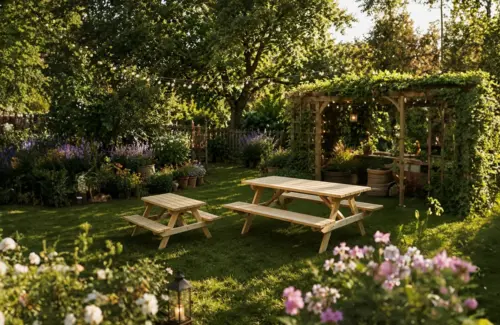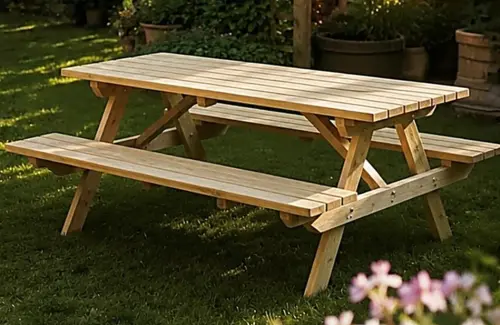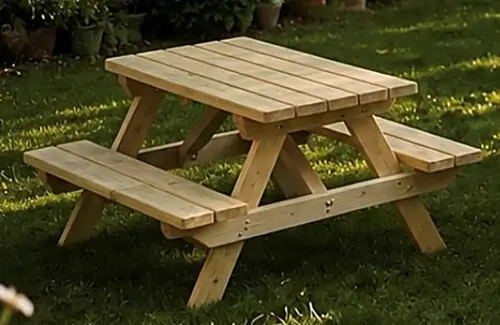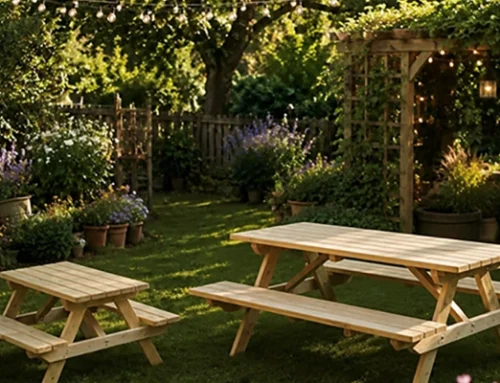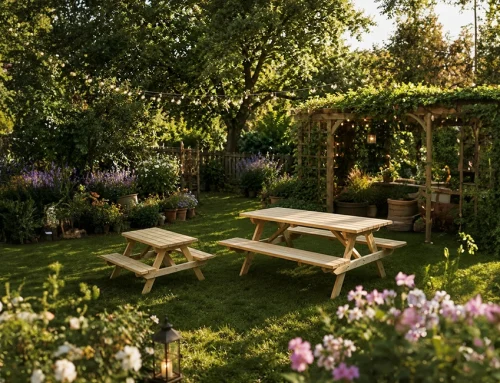

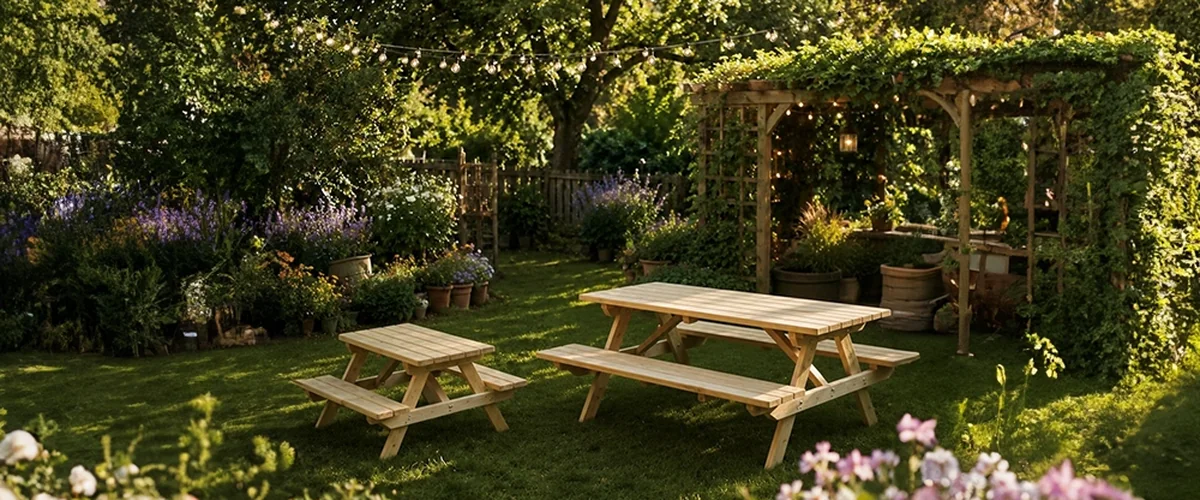
A picnic bench base is what separates a bench that feels solid from one that lurches every time somebody sits down at the end of it. Most people put a bench on the lawn, discover within a fortnight that it rocks, wedge something under a leg, and live with it for years. It is an easily solved problem and solving it properly also addresses the other issue with benches on grass, which is that the feet sit in damp ground and rot from the bottom up. We supply outdoor furniture and the timber to base it on as part of our fencing and timber supplies in Clitheroe.
Why a bench on grass never quite settles
A picnic bench has a wide footprint and a rigid frame. That is what makes it stable when it is supported evenly and what makes it rock when it is not. Unlike a chair, it cannot flex to accommodate uneven ground, so any variation in level goes straight into the frame.
Grass is never flat. It has a fall, it has hollows, it has soft patches and firm patches. Put a rigid frame on it and one foot will be carrying less than the others. Then people sit down, the loaded feet sink slightly into the turf, the balance changes, and the rock moves to a different corner.
The problem worsens over a season. Each foot compacts the ground beneath it at a different rate depending on the load it takes, so a bench that was almost level in May is noticeably out by August. Meanwhile the grass under the table dies off and the whole area turns into a worn patch.
What the damp is doing at the same time
Timber standing directly on soil or turf is in ground contact, and ground contact is the hardest condition timber faces. Moisture is drawn up into the end grain of the legs, and because the feet are the lowest and most shaded part of the bench they dry slowly and stay damp longest.
That is why benches almost invariably fail at the feet while the tabletop is still perfectly sound. Lifting the bench clear of the ground onto a free-draining surface removes the single biggest cause of that failure and adds years to the furniture.
Options for a base
The simplest is a slab under each foot, bedded level. It is quick, it costs very little, and it lifts each foot clear of the turf. The weakness is that individual slabs can settle independently over time, so it needs checking occasionally, but for a bench that gets moved around it is flexible and easy.
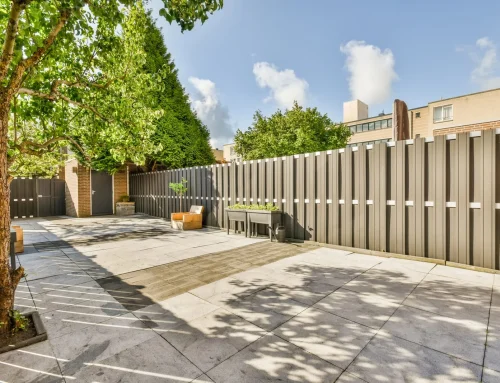
A better long-term answer is a small area of hard standing sized to take the bench plus room to walk around it. Sized properly, it means the bench sits level, the ground underneath does not turn to mud, and there is somewhere dry to stand while serving food. Allow considerably more area than the bench footprint, because people need room to swing their legs over the seat and step back.
For a bench on a lawn where you want to keep the grass, a frame of timber sleepers filled with compacted gravel makes an excellent base. It drains freely, it stays level because the frame holds the material in place, and it reads as a deliberate feature rather than a slab dropped on a lawn.
Getting it level and keeping it level
Check across both diagonals as well as along the length and width. A base that is level in two directions can still be twisted, and a twist is exactly what produces a rock in a rigid frame.
Compact the ground before laying anything on it. Whatever the base is made of, it will settle to match the ground beneath, so ground that has not been firmed will produce a base that goes out of level in its first season regardless of how carefully it was laid.
Give the base a very slight fall so water runs off rather than sitting on it. Dead level holds water in the low spots that inevitably develop.
Anchoring where it is needed
On an exposed site, in a garden that backs onto open ground, or anywhere the bench sits in a publicly accessible spot, fixing it down is worth doing. Concrete anchor bolts through the frame into a slab or hard standing hold it securely and stop it being moved.
The other reason to anchor is stability in use. A bench with somebody heavy sitting at one end of a seat is trying to tip, and a fixed bench cannot. In a garden used by children that is a real consideration.
Position and shade
Think about where the sun is at the time you actually use the bench. A spot that is beautiful at midday may be in full shade by six, which is when most people are eating outside in August.
Keep it off the wettest part of the garden and away from anything that drips on it. Under a tree sounds appealing and means sap, bird droppings and a permanently damp table that grows algae faster than anywhere else in the garden.
Customers setting up seating areas around Downham fencing and near Worston fencing often prepare the base at the same time as the boundary work, since the materials overlap.
Our outdoor furniture and picnic benches ranges cover the seating, with timber sleepers for a frame and the anchors in fixings and accessories.
If you want help sizing a base for a particular bench, ring 01200 449930 with the dimensions. Delivery is free on orders over £150 across all BB postcode areas.