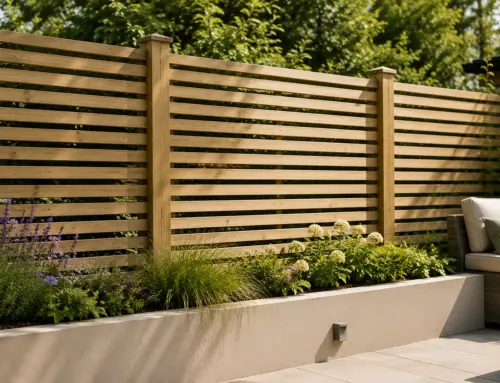

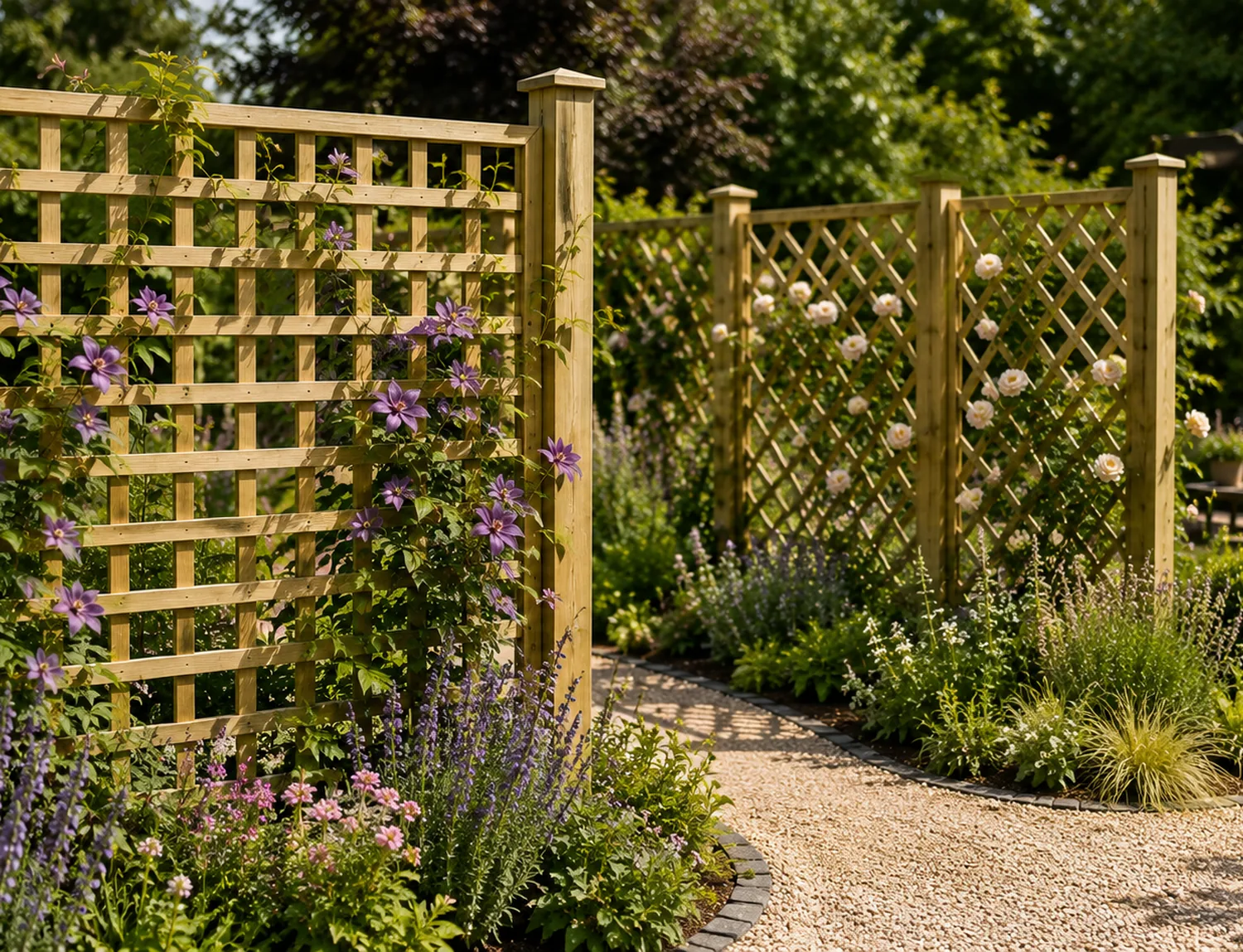
Garden trellis squares are one of the most flexible things you can buy for a garden, and one of the most frequently used badly. A square trellis panel is not a fence panel, it is not a screen on its own, and it will not survive being treated as either. Used properly, it adds height, supports climbers, breaks up a space and softens a hard boundary at a fraction of the cost of anything else. We supply both the standard and the Chelsea patterns as part of our fencing and timber supplies in Clitheroe, and the choice between them comes down to more than appearance.
What a square trellis panel is designed to do
A square trellis is a light lattice framework meant to carry plants and define space. It is deliberately open, deliberately light and deliberately not structural. That openness is the point. It lets wind through rather than resisting it, it lets light through to whatever is growing behind it, and it gives a climber something to grip without presenting a solid face.
Where people go wrong is expecting it to do a solid panel’s job. A trellis fixed as a boundary will not give privacy on its own until something is grown up it, and it will not take the wind load a panel takes. Understand it as a plant support and a visual divider and it will serve for years.
The difference between standard and Chelsea patterns
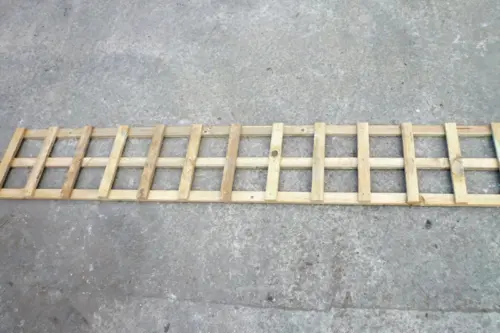
The standard pattern is the familiar open square lattice, with the battens spaced to leave generous openings. It is the lighter of the two, it is the more economical, and it is the one to use where a climber is going to cover it anyway and the trellis is essentially a framework that will disappear from view.
The Chelsea pattern is the tighter, more closely spaced lattice. The smaller openings give a more finished, more decorative appearance, they provide considerably more fixing points for a climber to grip, and they read as more of a screen even before anything grows on them. Where the trellis is going to be seen rather than covered, or where it is being used as a decorative feature in its own right, the closer pattern justifies the difference in cost.
There is a practical dimension too. A tighter lattice presents more surface to the wind. On an exposed site, the more open standard pattern is easier on its fixings.
Using trellis on top of an existing boundary
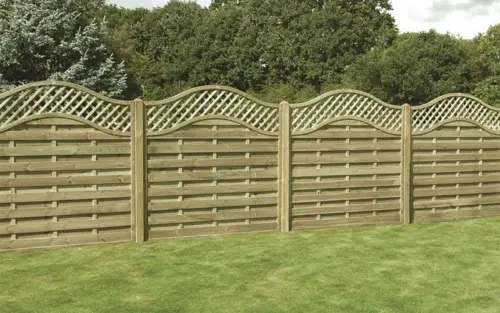
The most common use is adding height to a fence that is not quite tall enough, and the most common mistake is fixing the trellis and hoping. A trellis added on top of a fence increases both the height and the surface area of that fence, which increases the load on the posts. If the posts were adequate for the original height, they may not be adequate for the new one, particularly once a climber has grown over the trellis and turned an open lattice into something much closer to a solid sail.
Check the posts before adding height. A post that is sound but only just long enough may need extending or replacing, and it is far less work to establish that first than to find out during the first autumn gale.
Using trellis against a wall
Fixing trellis flat against a wall is the other classic use and it needs a gap behind it. Battening the trellis off the wall gives air movement behind the plant, keeps the growth off the masonry and gives stems something to twine around rather than being pressed flat against brick. It also means the trellis can be unhooked and lowered with the plant still on it if the wall ever needs attention.
Fixing and treating
Trellis is light timber and it does not take heavy fixings well. Use fixings suited to the section rather than the biggest thing to hand, and support it at enough points that no part of the frame is carrying an unreasonable span. Fix it into the frame rather than the lattice.
Treat it before it goes up. Once a climber is established on a trellis, treating it properly again is realistically impossible without cutting the plant back hard, so the coat it goes up with is the one it lives with for a long time. This is worth an hour on a dry day.
Choosing for the job in hand
If it is going behind a fast, vigorous climber and will be invisible within two seasons, the standard pattern is the sensible buy. If it is a decorative screen dividing a seating area from a vegetable patch, framing a doorway, or going somewhere it will be looked at, the Chelsea pattern is worth it. If it is on an exposed boundary, favour the more open pattern and pay attention to the posts.
Customers adding screening around Darwen fencing and out towards Wilpshire fencing often take trellis at the same time as panels so the timber weathers together, which avoids a mismatch of tone a season later.
The trellis sits alongside our decorative fence panels and trellis range, the traditional fence panels section and the fence posts that carry it.
If you are unsure which pattern suits what you are planning, ring 01200 449930 and describe the position and what is going to grow on it. Delivery is free on orders over £150 across all BB postcode areas.